
It's not just About Ticket Size, Type of Capital Matters.
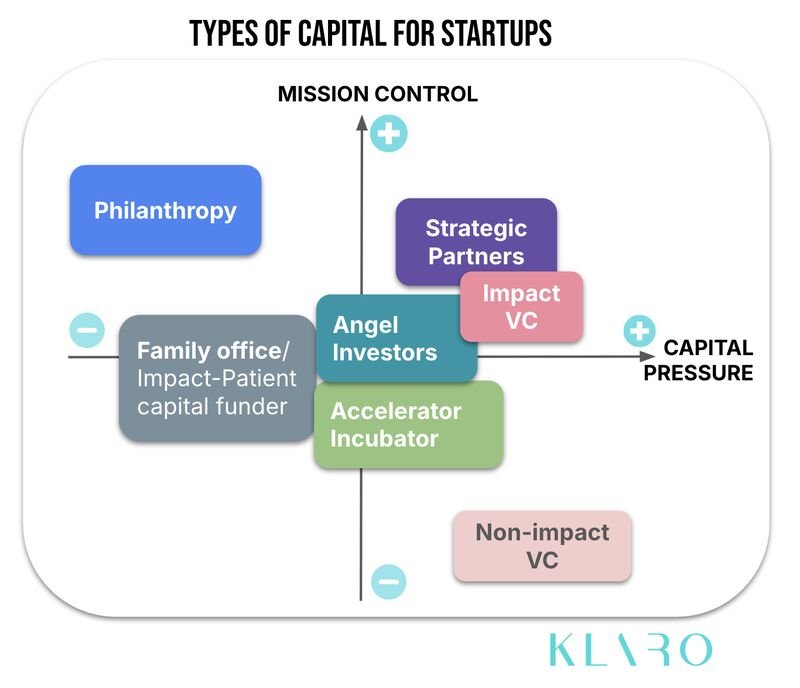
Choosing the right type of capital is one of the most consequential decisions an impact founder makes — and it needs to happen before you start planning your raise. This post breaks down the main funding options available to early-stage founders, what each one demands from you, and what to watch out for when building your funding strategy.
Most fundraising conversations start with the wrong question. Founders ask "how much should we raise?" before they've asked the more important one: "what kind of capital is right for us?"
The type of capital you choose shapes far more than your bank balance. It determines who you're accountable to, how much control you retain, what pace of growth you're committing to, and whether your mission is protected or quietly compromised over time. Getting this right before you start outreach is not a nice-to-have — it's foundational.
The decision depends on four things: the development stage of your company, the stability of your cash flows, the speed of growth your model can support, and how much control and dilution you're willing to accept. There is no universally right answer, but there are better and worse fits depending on where you are.
The main funding options for early-stage impact founders
Grants
Grants are non-dilutive capital — you don't give up equity or take on repayment obligations. For early-stage impact ventures, a grant can do more than fund a phase of work: it signals credibility, can unlock additional financing from other sources, and gives you runway to build without the pressure of investor return expectations.
The trade-offs are real, though. Application processes are time-intensive, and the timeline from application to funding can range from three months to over a year — difficult to plan around if you have near-term capital needs. Ticket sizes are often lower than equity routes, and grants generally can't serve as your sole source of runway once you're scaling.
Grants work best when used strategically: to de-risk early development, prove out a concept, or complement other capital rather than replace it.
Angel Investors
Angels can move quickly — often much faster than institutional investors — and the best ones bring more than money. Mentorship, sector networks, introductions to follow-on investors, and credibility can all come with an angel relationship, particularly if the investor has relevant experience in your space.
The challenge is finding the right one. Angels are harder to identify and access systematically than institutional funds, and deal terms vary widely. If the investment involves equity, you're giving up some ownership and, depending on the terms, some degree of influence over decisions. That's not inherently a problem — but it's worth being deliberate about who gets a seat at the table and on what terms.
Crowdfunding
Crowdfunding is often underestimated as a strategic tool. Done well, it does more than raise money: it validates market demand, builds community around your mission, and generates public momentum that can support future fundraising. The structure is also flexible — equity, debt, revenue share, and reward-based models all exist within the crowdfunding space.
The demands are significant, though. A successful campaign requires strong storytelling, a clear value proposition, and genuine traction or community to activate. Because the outcome is public, a campaign that underperforms is visible — something to factor into your timing and preparation. Platform fees and the operational effort of running a campaign are also real costs to account for.
Incubators and Accelerators
Programmes like accelerators offer something distinct from pure capital: structured support, peer-to-peer learning, mentorship, and access to networks that can take years to build independently. The brand association with well-known programmes can carry long-term value in terms of credibility and investor signalling.
The caveats: not all programmes include funding, and those that do often provide it at lower ticket sizes. Programme timelines are fixed, so your application and readiness have to align with their cohort cycles. It's worth researching thoroughly — the quality of support, the relevance of the network, and the reputation of the programme vary significantly.
Family Offices
Family offices represent a category of capital that is often overlooked by early-stage impact founders, partly because it's harder to access through standard channels. But for mission-driven businesses, they can be an excellent fit. Family offices tend to operate with longer time horizons than institutional investors, less pressure on exit timelines, and genuine flexibility on deal structure. Many are explicitly mission-aligned and willing to engage with blended return expectations.
The access challenge is real — decision-making processes can be opaque and relationship-driven, and expectations vary widely from one family office to another. Building these relationships typically takes time. But when the fit is right, family office capital can be among the most patient and strategically supportive available to impact founders.
Venture Capital
VC offers the largest ticket sizes, the ability to fund multiple growth rounds, and significant non-financial value — networks, talent, partnerships, follow-on investor credibility. For impact startups with genuinely scalable models and large addressable markets, it can be the right fuel for the right stage.
But VC is not neutral capital. It comes with high growth expectations, exit timelines driven by fund structures, dilution, and a degree of control transfer that not all founders are prepared for. Not all VC funds understand or prioritise mission alignment — and even impact VCs, as we explored in a previous post, are still VCs with LP obligations and return targets. Taking VC capital from the wrong fund, even a well-intentioned one, can create real tension between financial performance and mission over time.
What impact founders specifically need to watch out for
Avoid taking capital just because it's available. When you're tight on runway, the temptation to take the first cheque that comes your way is understandable. But this is the beginning of a long-term relationship — not a transaction. The wrong investor, even one with good intentions, can create friction, dilution of focus, and mission drift that costs far more than the capital was worth.
You don't have to pursue impact capital exclusively — but know the implications. There's no rule that says impact businesses must only raise from impact-labelled investors. Plenty of strong impact companies have raised from generalist angels, family offices, or mainstream VCs. What matters is being clear-eyed about the implications: will this funder push you toward decisions that maximise top-line growth at the expense of your impact model? Can you hold the line on mission if there's pressure to pivot?
Think about your cap table as a whole, not investor by investor. Each funding decision shapes your ownership structure and the stakeholder dynamics that follow. Before you raise, think about what your ideal cap table looks like — not just at this round, but over the next two or three. How much dilution are you comfortable with in total? Who do you want around the table when hard decisions need to be made? Thinking about this holistically rather than optimising each deal independently leads to much better long-term outcomes.
A note on blended capital structures
For many impact businesses — particularly those addressing systemic problems or serving underserved markets — a single capital type isn't the answer. Blended structures, combining grant funding with equity or debt, are increasingly common and can be a smart way to de-risk early stages while preserving optionality for growth capital later.
A grant that funds R&D or proof of concept, followed by angel investment to scale what's proven, followed by institutional capital when the model is established — this kind of staged, intentional approach to the capital stack is worth thinking through early, even if the full picture isn't clear yet.
Choosing the right capital is not just a financial decision. It's a strategic one that shapes the kind of company you build and the kind of mission you can sustain. Getting it right starts with understanding your options clearly — and then mapping them honestly to where you are and where you're going.

At KLARO Impact, we support founders in mapping the right investors for them, accompanying them in the fundraising process, and sharpening their pitch. If you're preparing a raise, this is where readiness begins.
